Clinic Blog Not Ranking? Need to Fix SEO OR Content Strategy
Published: September 23, 2026 | Author: Maria Kanwal, Healthcare SEO Strategist
If you run marketing for a medical or aesthetic clinic, you’ve likely heard the common advice: “Post more blogs to boost your Google rankings.” So you start publishing several articles every month. Yet, your rankings remain stuck, organic traffic isn’t growing, or it might even be declining.
Here is the reality after analyzing numerous medical and aesthetic clinic sites:
“Publishing volume was never the primary issue; the underlying content strategy was.”
This guide explains the underlying pitfalls, highlights exact keywords potential patients search for, details how to structure articles to rank in standard search and AI Overviews, and demonstrates how clinics can leverage AI effectively as a support tool rather than a replacement for quality.
1. Why Clinic Content Underperforms Even When It’s “Well-Written”
Healthcare and aesthetic content faces unique ranking challenges because Google categorizes it under YMYL — Your Money or Your Life.
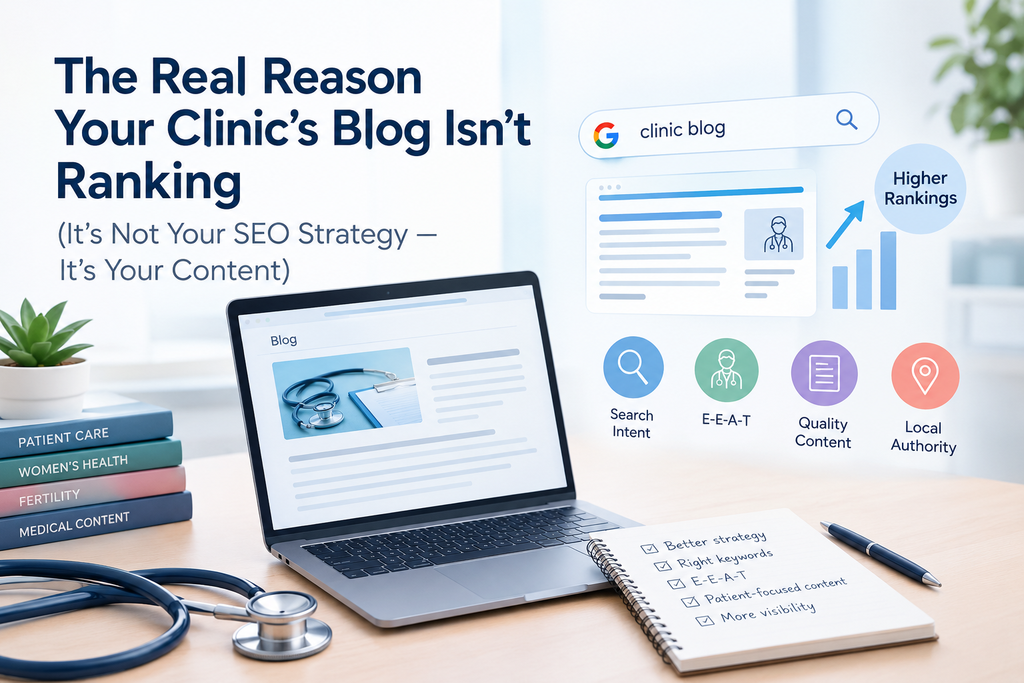
YMYL encompasses topics that could affect a reader’s physical health, finances, or safety if misleading. Medical and aesthetic treatments fall directly into this group. Consequently, search algorithms and human raters enforce strict standards for E-E-A-T: Experience, Expertise, Authoritativeness, and Trustworthiness.
In practice, this means:
- Broad, generic content is demoted far more quickly than in other niches
- Articles lacking clear medical credentials struggle to gain traction, regardless of accuracy
- Repetitive or thin content faces strict penalties
- Unreviewed AI text is easily detected and routinely distrusted by search engines and readers alike
Most clinics fail to rank not due to poor writing, but because their articles lack distinct local authority and clinical expertise.
2. The 11 Most Common Content Mistakes in Medical/Aesthetic SEO
A review of multiple clinic websites reveals recurring errors:
- Publishing dozens of generic, AI-style blogs: Content generated at scale without a distinct clinical voice or local depth.
- Multiple articles targeting nearly the same keyword: Creating many overlapping posts leads to keyword cannibalization, confusing search engines and suppressing overall rankings.
- Optimizing for keyword density instead of search intent: Repeating phrasing endlessly without directly answering patient questions provides little value.
- Writing “What is Botox?” when the site needs a strong “Botox in |region|” service page. Basic informational articles cannot replace dedicated, high-converting service landing pages.
- Using the same structure and wording across different clinics: Interchangeable content that fits any competitor fails to build brand authority.
- Making unsupported superlative claims: Users ignore labels like “top” or “leading” without backing evidence, and search algorithms discount them.
- Publishing content without genuine doctor input: Anonymous articles lacking practitioner oversight fail to establish necessary credibility.
- Ignoring outdated details: Leaving old pricing or discontinued procedures damages patient trust.
- Padding articles with generic FAQs: Adding filler questions solely for length rather than addressing real patient concerns.
- Publishing blog content with no internal links to service pages: Failing to guide blog readers toward booking and treatment landing pages.
- Measuring success by rankings alone: High ranks for non-converting search terms do not translate to patient inquiries.
3. Search Intent 101 — The Framework Most Clinics Skip
Search requests split into four main categories. Aligning content with these categories is vital for search performance.
| Intent Type | What the Patient Wants | Example Query | Best Content Type |
|---|---|---|---|
| Informational | To learn something | “how does Botox work” | Blog post |
| Commercial investigation | To compare options before deciding | “Botox vs filler for forehead lines” | Blog post or comparison guide, linked to service pages |
| Transactional | Ready to book or inquire | “Botox clinic near me” | Service page |
| Navigational | Looking for a specific clinic/brand | “[Clinic name] Botox prices” | Homepage / service page |
Clinics frequently focus too heavily on basic informative blogs while neglecting high-intent service pages that drive patient conversions.
4. Keyword Research: What Patients Are Really Searching For
Mapping queries by search intent clarifies user needs. Always verify monthly search volumes and competition levels using tools like Google Keyword Planner, Ahrefs, or Semrush for your specific market.
Informational queries (top of funnel)
- “how does [treatment] work”
- “how long does [treatment] last”
- “[treatment] recovery time”
- “[treatment] side effects”
- “is [treatment] painful”
- “[treatment] vs [alternative treatment]” (e.g., “Botox vs Dysport”)
- “what age should I start [treatment]”
Commercial investigation queries (mid funnel — often underserved)
- “[treatment] cost in [city]”
- “how many sessions of [treatment] do I need”
- “[treatment] before and after [specific area/concern]”
- “best [treatment] clinic in [city]” (you can’t win the word “best” with a claim — you win it by being genuinely the most detailed, trustworthy answer)
- “[treatment] for [specific skin type/condition]”
- “non-surgical alternative to [procedure]”
Transactional / local queries (highest intent, often lowest competition locally)
- “[treatment] clinic in [neighborhood]”
- “[treatment] doctor near me”
- “book [treatment] consultation [city]”
- “[treatment] price list [city]”
- “same week [treatment] appointment”
- “[treatment] clinic open [day/time]” (e.g., “Botox clinic open Saturday”)
Reassurance / trust queries (rarely targeted, high value)
- “[treatment] gone wrong”
- “[treatment] not working”
- “how to choose a safe [treatment] clinic”
- “[treatment] risks explained”
- “questions to ask before getting [treatment]”
Addressing safety concerns and provider evaluation builds vital trust with prospective patients while satisfying search engine guidelines.
5. Low-Competition, High-Intent Keyword Opportunities Most Clinics Miss
Broad terms like “Botox Manchester” face heavy competition from established providers. Targeting long-tail, specific queries offers a faster route to reaching motivated searchers.
Key long-tail patterns include:
- Treatment + demographic: “Botox for men in [city]”, “filler for mature skin [city]”
- Treatment + very specific concern: “filler for under-eye hollows”, “Botox for gummy smile”, “treatment for nasolabial folds”
- Treatment + occasion: “Botox before wedding timeline”, “filler touch-up before event”
- Treatment + comparison the patient is actually confused about: “thread lift vs facelift”, “Botox vs Xeomin difference”
- Treatment + specific worry: “will Botox look natural”, “how to avoid frozen look with Botox”
- Aftercare queries: “what not to do after filler”, “how to sleep after Botox”
- Neighborhood-level local queries: rather than just “[city]”, target specific neighborhoods or districts your patients actually live or work in
Supporting a single service page with targeted long-tail blog posts builds topic authority and guides users toward booking.
6. How to Structure Content to Rank in Google and AI Overviews
AI search features highlight content that delivers clear, direct answers. Proper formatting benefits both conventional rankings and AI summary placement.
- Answer the question immediately: Provide concise facts right under the heading before elaborating.
- Match headings to real queries: Use subheadings that reflect the phrasing searchers actually type into search engines.
- Use structured elements deliberately: Include comparison charts, numbered step lists, and direct Q&A blocks.
- Attach real credentials to claims: Highlight specific physician qualifications, experience, and certifications to establish trust.
- Replace vague superlatives with verifiable specifics: Cite concrete data, such as years of operation or verified review totals, instead of subjective praise.
- Link every blog post to the service page it supports: Ensure that informational readers connect directly to conversion opportunities.
- Keep pages updated, not just published: Regularly refreshing service details and medical bios signals active accuracy to search engines.
7. How Clinics Can Actually Use AI (Without Wrecking Trust or Rankings)
AI tools excel at research and structuring, provided human clinical experts review and refine all final statements prior to publication.
Where AI helps:
- Keyword and topic research at scale: Grouping search questions, spotting content gaps, and identifying keyword overlap
- Outline and first-draft generation: Generating initial subheadings and structures for medical writers to expand
- Content audits: Scanning existing libraries to locate duplicate topics, outdated facts, or thin pages
- Patient-facing chat tools: Addressing basic inquiries regarding general pricing, recovery, or scheduling
- Internal linking suggestions: Identifying logical link paths between blog articles and service offerings
- Personalizing follow-up content: Customizing follow-up communications based on specific treatment interests
Where AI use backfires:
- Publishing unverified drafts without practitioner review
- Allowing AI to generate unbacked medical claims or statistics
- Mass-producing redundant posts that compete against each other for the same terms
- Removing human medical oversight, which triggers E-E-A-T penalties
Top-performing clinics use AI to streamline planning and audits while maintaining professional medical oversight across all published work.
8. A Practical Content Audit Checklist You Can Run This Week
- Inventory all published blogs and treatment pages
- Categorize pages by keyword target to spot overlap
- Consolidate competing articles into single, comprehensive resources
- Ensure every blog links directly to its parent service page
- Update outdated pricing, location details, and treatment protocols
- Replace unsupported claims with verifiable clinical details
- Verify that every service page identifies treating practitioners and credentials
- Identify high-intent, long-tail terms missing from your content strategy
9. The Metrics That Actually Matter
Shift focus away from: “How many blogs did we publish this month?”
Focus instead on:
- Which content directly drives consultation inquiries?
- Which overlapping articles require consolidation?
- How well are transactional local pages ranking compared to informational blogs?
- Is overall content quality and clinical depth improving?
Evaluating meaningful outcomes rather than production volume leads to improved search visibility and consistent patient bookings.
Conclusion
The clinics that win in search aren’t the ones publishing the most content, they’re the ones publishing the right content. As this guide has shown, ranking struggles almost always trace back to strategy gaps: overlapping articles competing against each other, informational posts standing in for high-converting service pages, and generic writing that fails to meet Google’s E-E-A-T standards for YMYL topics.
The fix isn’t complicated, but it does require discipline. Start with a content audit. Identify where cannibalization is happening, consolidate overlapping posts into authoritative resources, and make sure every blog article has a clear path to a service page. Map your content to real search intent, informational, commercial investigation, transactional, and trust-building, so patients find exactly what they’re looking for at each stage of their decision.
AI can accelerate this process, but it can’t replace clinical expertise. The clinics that will outperform competitors over the next few years are the ones pairing smart, intent-driven content strategy with genuine practitioner oversight, not the ones chasing publishing volume.
If your clinic’s rankings have plateaued despite regular blogging, the problem likely isn’t effort. It’s strategy. A focused content audit, reviewing cannibalization, outdated information, and keyword gaps, is often the fastest path to renewed visibility and more patient bookings.
Ready to fix your clinic’s content strategy? Reach out to medrankseo@gmail.com for a comprehensive content audit tailored to your site.
10. FAQs
Does more blog content always improve SEO for a clinic?
No. Publishing higher volume helps only when each page targets distinct search intent and supports main service pages. Duplicate or overlapping posts can trigger keyword cannibalization and reduce rankings.
Is AI-generated content bad for medical SEO?
Not automatically; however, unedited AI copy struggles on YMYL topics because it lacks verified medical credentials and unique clinical insight. AI functions best for planning and initial drafts under strict practitioner supervision.
What’s the fastest fix for a clinic with years of accumulated blog content?
Start with a cannibalization review. Merging redundant posts into comprehensive, well-linked guides often yields quicker ranking gains than creating brand-new articles.
Should clinics target “best [treatment] in [city]” keywords?
Unsubstantiated claims are discounted by users and search engines alike. Instead, provide detailed, evidence-backed answers and clear credentials for your local area to capture high-intent searchers effectively.