AI Tools for Healthcare: The Complete 2026 Guide to Artificial Intelligence in Medical Content, SEO, and Patient Care
Artificial intelligence is reshaping the healthcare industry faster than any technology since the electronic health record. In 2026, AI tools are being used across the full spectrum of healthcare, from clinical decision support and diagnostic imaging to patient communication, medical content creation, and healthcare marketing. For healthcare organizations, clinics, and health content brands, understanding which AI tools are transforming the industry and how to implement them strategically is no longer optional, it is a competitive necessity.
This comprehensive guide covers the landscape of AI tools for healthcare in 2026: what they are, what they do, which are worth investing in, how they intersect with healthcare SEO and content strategy, and what ethical and regulatory considerations every healthcare organization must understand before deploying AI in patient-facing contexts.
| Quick Answer |
| AI tools for healthcare in 2026 span three major categories: |
| • Clinical AI: diagnostic support, imaging analysis, clinical documentation |
| • Operational AI: scheduling, billing, revenue cycle management |
| • Content AI: medical writing assistance, SEO optimization, patient communication |
| Each category carries distinct benefits, risks, and regulatory considerations. |
What You Will Learn in This Guide
- The major categories of AI tools being used in healthcare today
- The top AI tools for healthcare content creation and healthcare SEO in 2026
- How AI is changing patient communication and digital healthcare marketing
- The risks, limitations, and ethical considerations of AI in healthcare
- How to evaluate and select AI tools for your healthcare organization
- How AI search is changing the way patients find health information
- A framework for integrating AI tools into your healthcare content strategy
The Healthcare AI Revolution: Why 2026 Is the Inflection Point
The global healthcare AI market exceeded $45 billion in 2024 and is projected to grow at a compound annual rate of over 45% through 2030. Driving this growth is the convergence of three forces:
- The maturation of large language models capable of processing complex medical knowledge
- The expansion of multimodal AI that can analyze imaging, text, and structured data simultaneously
- The urgent healthcare workforce crisis is pushing institutions to seek AI-assisted efficiencies
For healthcare organizations and health content brands, this inflection point creates both opportunity and risk. Organizations that adopt AI tools strategically, with appropriate clinical oversight, regulatory awareness, and ethical guardrails, will gain significant competitive and operational advantages. Those that adopt AI carelessly, or fail to adopt it at all, will fall behind.
The Three Waves of Healthcare AI Adoption
Wave 1 (2018–2022): Administrative and operational AI: scheduling, coding assistance, basic automation. Low clinical risk, high efficiency gain. Now table stakes for large health systems.
Wave 2 (2022–2024): Content and communication AI: AI-assisted medical writing, chatbot patient communication, AI-powered SEO tools. Rapidly adopted by health content brands and digital health companies.
Wave 3 (2024–present): Clinical and diagnostic AI: FDA-cleared AI diagnostic tools, AI-assisted surgical planning, ambient clinical documentation, AI-powered genomics. Entering mainstream clinical adoption with significant regulatory oversight.
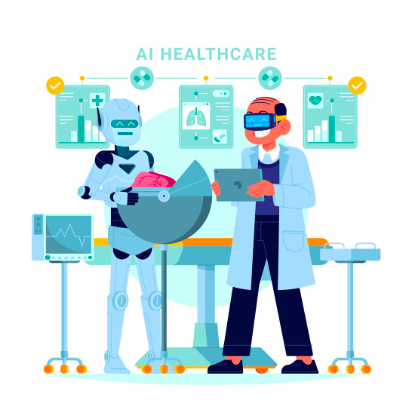
Category 1: AI Tools for Clinical Decision Support and Diagnostics
Clinical AI tools support physicians and other healthcare providers in making more accurate, more efficient, and better-evidenced clinical decisions. This category has seen the most rigorous development and the most significant regulatory scrutiny.
AI Diagnostic Imaging Tools
AI-powered radiology and pathology tools are among the most mature and clinically validated AI applications in healthcare. These tools analyze medical images: X-rays, CT scans, MRIs, and pathology slides, and flag abnormalities, prioritize worklists, and provide quantitative measurements that support radiologist interpretation.
- Chest X-ray AI tools can detect findings associated with pneumonia, pleural effusion, and pulmonary nodules with sensitivity comparable to experienced radiologists
- Dermatology AI tools analyze skin lesion images to support early melanoma detection
- Ophthalmology AI tools screen for diabetic retinopathy and macular degeneration in retinal photographs
- Pathology AI tools analyze digitized tissue slides for cancer detection and grading
These tools are designed as decision support, not decision replacement. Regulatory bodies, including the FDA, require that FDA-cleared clinical AI tools be used under physician oversight, with the clinician retaining final diagnostic authority.
Best AI Tools for Automating Clinical Documentation in 2025 2026
Ambient AI documentation tools, which listen to physician-patient conversations and automatically generate clinical notes, are among the fastest-growing AI applications in outpatient and inpatient settings. The best AI tools for automating clinical documentation in 2025–2026 include Nuance DAX, Abridge, and Suki, which have demonstrated reductions in documentation time of 50–70%.
These tools directly address one of healthcare’s most acute crises: the documentation burden that takes physicians away from patient care and contributes to clinician burnout. For healthcare organizations evaluating ambient AI, the business case is compelling, and the technology is now clinically mature enough for broad deployment.
- Nuance DAX: Deep EHR integration, widely deployed in large health systems
- Abridge: Strong performance in outpatient and specialty care settings
- Suki: Lightweight, fast adoption curve for independent practices
Clinical Decision Support AI
AI-powered clinical decision support systems integrate with electronic health records to provide real-time recommendations for medication dosing, drug interactions, sepsis early warning, and care pathway optimization. These systems analyze patient data against clinical guidelines and flag situations where intervention may be warranted: helping clinicians catch the cases that might otherwise be missed in a high-volume practice.
Category 2: AI Tools for Healthcare Operations
Operational AI addresses the administrative and logistical complexity of running healthcare organizations efficiently. This is where AI delivers the fastest and most measurable ROI for most healthcare organizations.
AI-Powered Patient Scheduling and Access
AI scheduling tools use machine learning to predict no-show probability, optimize appointment slot allocation, match patients to appropriate care settings, and reduce scheduling friction through conversational AI interfaces. Health systems that have deployed AI scheduling report reductions in no-show rates of 20–35% and significant improvements in same-day appointment availability.
Revenue Cycle AI
Revenue cycle management is one of the most complex administrative functions in healthcare, and AI is transforming it. AI tools now automate prior authorization, predict claim denial risk, optimize coding accuracy, and reduce days in accounts receivable. For hospital systems and large practices, revenue cycle AI is generating measurable financial improvements of millions of dollars annually.
AI Chatbots and Patient Communication Tools
Conversational AI tools are being deployed across healthcare websites, patient portals, and messaging platforms to handle appointment scheduling, prescription refill requests, symptom triage, and frequently asked patient questions. Well-designed healthcare chatbots reduce call center volume, improve after-hours patient access, and free clinical staff for higher-value interactions.
| Important for Healthcare Marketers |
| AI chatbots deployed in patient-facing contexts must be clearly identified as AI. |
| They must not provide clinical advice without clinical oversight. |
| They must be designed with clear escalation pathways to human care. |
| HIPAA compliance and ADA accessibility are non-negotiable requirements. |
Category 3: AI Tools for Healthcare Content and SEO
This is the category most relevant for healthcare marketers, medical content teams, and health SEO professionals. The best AI tools for content creation in healthcare fall into several distinct subcategories, each with different use cases, capabilities, and compliance considerations. AI tools for healthcare content and digital marketing are evolving rapidly and creating genuine productivity gains when used strategically and with appropriate clinical oversight.
AI Tools for Medical Writing 2026: Latest Updates
The landscape of AI tools for medical writing has shifted significantly in 2026. A new generation of healthcare-specialized models has emerged alongside general-purpose tools, giving medical writers more choice and more complexity than ever before. Here is what is new and what matters most this year.
What Changed for AI Medical Writing Tools in 2026
- Healthcare-specific fine-tuned models now available: trained on clinical literature, drug references, and FDA guidance documents
- Multimodal capabilities: tools can now process lab reports, imaging descriptions, and clinical notes alongside text
- Improved citation verification: leading tools now flag potentially hallucinated references in real time
- Tighter EHR integration: AI writing tools increasingly connect directly with Epic, Cerner, and other platforms
- Enhanced E-E-A-T compliance features: built-in prompts for expert attribution and source citation
Key Principle for 2026: AI tools for medical writing in 2026 are more capable than ever, but the fundamental rule has not changed: every piece of AI-assisted health content requires human clinical review before publication. AI is the accelerator; expert review is the safety system.
Best AI Tools for Medical Content Creation in 2025 2026
The best AI tools for medical content creation in 2025–2026 combine strong language generation with healthcare-specific guardrails. The best AI for medical writing balances speed with clinical accuracy and, critically, supports the human review workflow rather than bypassing it.
Top AI Tools for Healthcare Content Creation
- Claude (Anthropic): Strong performance on nuanced clinical content; excellent for long-form medical articles and evidence synthesis
- Best for: Medical blog posts, white papers, patient education content, healthcare SEO articles
- ChatGPT-4o (OpenAI): Widely adopted; best results with detailed medical prompts and structured output requests
- Best for: First drafts, content outlines, FAQ generation, patient-facing copy
- Gemini Advanced (Google): Integrated with Google search; useful for real-time medical literature awareness
- Best for: Research synthesis, fact-checking support, healthcare news summaries
- Jasper Health: Specialized healthcare writing assistant with compliance features
- Best for: Healthcare marketing copy, clinic websites, patient communication
- Writesonic Medical: Healthcare-specific templates for medical practices
- Best for: Medical practice marketing, service page content, healthcare ads
Best AI Tools for Creating Healthcare Proposals Quickly 2026
For healthcare organizations that need to produce grant proposals, clinical study protocols, partnership proposals, or service documentation quickly, AI tools offer significant time savings. The best AI tools for creating healthcare proposals quickly in 2026 include:
- Claude: Excels at structured document generation; can produce a complete proposal framework in minutes
- ChatGPT with custom instructions: Effective for filling templated proposal structures
- Notion AI: Good for teams collaborating on healthcare proposal documents in real time
- Gamma: AI-powered presentation tool; useful for visual healthcare pitch decks and proposal presentations
Best AI for Medical Writing: How to Choose in 2026
The best AI for medical writing 2026 depends on your specific use case. There is no single tool that leads across all medical writing scenarios. Here is a framework for choosing:
- For clinical content and E-E-A-T compliance, Claude or Gemini Advanced
- For high-volume healthcare blog content, ChatGPT-4o with a detailed style guide
- For medical practice websites and local SEO content, Writesonic Medical or Jasper Health
- For academic and research writing, Consensus AI or Elicit for literature synthesis
- For patient education materials, Claude or ChatGPT with plain language instructions
Recommended AI Tools for Medical Writers
| MedRankSEO Recommended AI Tools for Medical Writers |
| 1. Claude (Anthropic): Best overall for long-form clinical content and E-E-A-T compliance |
| 2. ChatGPT-4o: Best for versatility and high-volume content production |
| 3. Gemini Advanced: Best for real-time research synthesis and Google integration |
| 4. Consensus AI: Best for medical literature search and evidence-based writing |
| 5. Nuance DAX: Best for clinical documentation automation in practice settings |
All tools require clinical review before publication. None replace medical expertise.
Best AI Tools for Medical Literature Search in 2025 2026
An accurate medical literature search is the foundation of E-E-A-T compliant health content. The best AI tools for medical literature search in 2025–2026 bridge the gap between raw database search and synthesis:
- Consensus AI: Searches PubMed and extracts key findings; ideal for evidence-based content writing
- Elicit: An AI research assistant that summarizes papers and extracts methodology details
- Semantic Scholar: AI-powered academic search with citation graph analysis
- Perplexity Pro: Real-time web search with source citations; useful for recent clinical news
- Scite: Citation analysis tool showing whether papers support or contradict each other
AI Content Generation Tools for Healthcare HIPAA compliant
HIPAA compliance is a non-negotiable requirement for any AI tool that processes protected health information (PHI) in healthcare content workflows. Not all AI content generation tools are built with healthcare data privacy in mind, and deploying the wrong tool can create significant regulatory exposure.
What Makes an AI Tool HIPAA Compliant?
- Business Associate Agreement (BAA): The vendor must sign a BAA with your organization
- Data isolation: Your prompts and outputs must not be used to train shared models
- Encryption: Data must be encrypted in transit and at rest
- Access controls: Role-based access and audit logging must be available
- No data retention: Content submitted to the AI must not be stored beyond the session
HIPAA Compliant AI Content Generation Tools for Healthcare in 2026
- Microsoft Azure OpenAI Service: Enterprise HIPAA-eligible deployment of GPT models with BAA available
- Best for: Large health systems needing enterprise-grade compliance
- Google Cloud Healthcare AI: HIPAA-eligible Gemini deployment through Google Cloud
- Best for: Organizations already in the Google Cloud ecosystem
- AWS HealthLake + Bedrock: Amazon’s HIPAA-eligible AI infrastructure for healthcare
- Best for: Health systems with existing AWS infrastructure
- Nabla: HIPAA-compliant ambient clinical documentation AI
- Best for: Clinical note generation in patient care settings
| Important Compliance Note |
| Consumer-facing AI tools (ChatGPT.com, Claude.ai, Gemini.com) are NOT HIPAA compliant for PHI processing. |
| Always use enterprise/API versions with a signed BAA when handling any patient data. |
| For healthcare marketing content that contains NO patient data, standard tools may be used safely. |
AI SEO Tools for Healthcare Websites
AI-powered SEO platforms are transforming healthcare keyword research, content strategy, and competitive analysis. Tools in this category help healthcare content teams:
- Identify high-volume, low-competition healthcare keyword opportunities across the full patient journey
- Analyze search intent to determine whether a query requires informational, navigational, or transactional content
- Audit existing health content for E-E-A-T gaps, thin content, and optimization opportunities
- Monitor SERP feature ownership for healthcare keywords
- Analyze competitor content strategies to identify topics and formats driving their organic traffic
- Generate content briefs aligned with top-ranking competitor formats
Best AI Visibility Tools for Healthcare Content Marketing
Visibility in healthcare content marketing now requires optimization across traditional search, AI Overviews, and answer engines like Perplexity. The best AI tools for healthcare content marketing visibility SEO 2025 2026 address this multi-surface reality:
- Semrush: comprehensive healthcare keyword research, position tracking, and content gap analysis
- Best for: Keyword strategy, competitor analysis, backlink monitoring
- Ahrefs: deep backlink analysis and content explorer for healthcare topics
- Best for: Link building strategy, content research, SERP analysis
- Surfer SEO: AI-powered on-page optimization with real-time content scoring
- Best for: Content briefs, on-page optimization, NLP keyword integration
- BrightEdge: enterprise AI SEO platform with healthcare-specific features
- Best for: Large health systems tracking visibility across thousands of pages
- MarketMuse: AI content planning and topic authority scoring
- Best for: Building topical authority in healthcare niches
Best AI Content Generation Tools for Healthcare 2025 2026
Beyond writing assistance, a new category of AI content generation tools is emerging specifically for healthcare, combining content creation with compliance checking, medical fact verification, and SEO optimization:
- Jasper Health: healthcare-specific AI content generation with compliance guardrails
- Writesonic Medical: medical practice content generation with local SEO features
- Copy.ai: versatile content generation; works well for healthcare marketing with appropriate prompting
- Hypotenuse AI: supports medical e-commerce and supplement content at scale
- Aidaptive: personalized healthcare content generation based on patient journey data
AI for Healthcare Social Media and Patient Education
AI tools are streamlining healthcare social media content creation, helping health brands maintain consistent, compliant, and engaging social presence. AI tools can generate first-draft social content, repurpose long-form medical articles into platform-specific formats, and suggest optimal posting schedules based on audience engagement data.
For patient education specifically, AI tools are enabling more personalized content delivery: matching educational resources to patient demographics, health literacy levels, and care journeys. This personalization significantly improves patient engagement with health education content and supports better care outcomes.
AI for Healthcare Local SEO
AI tools are increasingly being used to optimize healthcare local SEO, the critical discipline that determines whether a clinic, hospital, or practice appears prominently when patients search for care near them. AI-powered local SEO tools help healthcare organizations manage Google Business Profile optimization, generate and respond to patient reviews, monitor local SERP performance, and identify local citation gaps.
How AI Search Is Changing the Way Patients Find Health Information
The patient search journey is being fundamentally disrupted by AI-powered search. Google’s AI Overviews now appear for a significant proportion of health queries, providing synthesized answers directly in the search results page. Perplexity, ChatGPT search, and Gemini are capturing a growing share of health information queries from users who prefer conversational AI interfaces over traditional search.
How to Optimize Content for Google AI Overviews Medical YMYL
Medical content falls under Google’s Your Money or Your Life (YMYL) category, meaning it faces the highest scrutiny for accuracy, authority, and trustworthiness. Optimizing YMYL healthcare content for Google AI Overviews requires a specific approach that goes beyond standard SEO.
YMYL Medical Content Optimization Framework
- Expert attribution: every health claim must be attributed to a named, credentialed clinical expert
- Direct question-answer format: AI Overviews pull from content that directly answers the query in the first 1–2 sentences
- Structured data markup: use MedicalWebPage, FAQPage, and HowTo schema to signal content type to Google’s AI
- Source citation: cite peer-reviewed studies, clinical guidelines, and government health sources
- Content freshness: update medical content regularly; AI systems favor recently verified information
- E-E-A-T signals: author bio with credentials, organization trustmarks, editorial review disclosure
What This Means for Healthcare Content Strategy
The rise of AI search does not make healthcare SEO obsolete: it makes authoritative, well-structured, expert-attributed healthcare content more valuable than ever. AI search systems source their summaries from the web’s most trusted content. If your health content is E-E-A-T compliant, well-structured, and richly cited, it is more likely to be the source that AI systems draw from, giving you visibility even when users do not click through to your website.
The Zero-Click Challenge for Healthcare Websites
AI search is accelerating the zero-click trend: searches that are resolved on the SERP without the user clicking through to any website. For healthcare content teams, this means optimizing for impressions and brand visibility alongside click-through rates. Being the cited source in an AI Overview builds brand recognition even without a click, and users who need deeper information are highly likely to click through to the authoritative source that AI cites.
| Forward-Looking Strategy |
| As AI search matures, the healthcare brands that will maintain strong patient acquisition from organic search are those that invest simultaneously in the following: |
| • AI search optimization (structured content, E-E-A-T, schema markup) |
| • Brand building that makes them the trusted source patients turn to after their initial AI search encounter |
Ethical and Regulatory Considerations for AI in Healthcare
No guide to AI tools for healthcare would be complete without addressing the significant ethical and regulatory considerations that govern, or should govern, AI deployment in clinical and patient-facing contexts.
FDA Regulation of Clinical AI
The FDA regulates AI tools used in clinical decision-making as Software as a Medical Device (SaMD). AI diagnostic tools, clinical decision support systems that replace or inform clinical judgment, and AI tools that analyze patient data to recommend care must meet FDA clearance or approval requirements. Healthcare organizations deploying clinical AI should verify the regulatory status of every tool and ensure compliance with FDA guidance.
HIPAA and AI Data Privacy
AI tools that process protected health information (PHI) must comply with HIPAA Privacy and Security Rules. This applies to AI documentation tools, AI chatbots that collect symptom information, AI tools that analyze patient records, and any AI platform that stores or processes identifiable patient data. Business Associate Agreements (BAAs) must be in place with all AI vendors who handle PHI.
Algorithmic Bias in Healthcare AI
Healthcare AI tools trained on historically biased datasets can perpetuate and amplify health disparities. Across multiple specialties, researchers have documented AI diagnostic tools that perform significantly better for some demographic groups than others. Healthcare organizations must demand bias audits and performance data stratified by race, gender, and socioeconomic status before deploying clinical AI.
AI Transparency and Patient Consent
Patients have an ethical right to know when AI tools are involved in their care. Healthcare organizations should maintain clear policies on AI use, communicate openly with patients about how AI tools support their care, and ensure patients can request AI-free care pathways where clinically feasible.
How to Evaluate and Select AI Tools for Your Healthcare Organization
The AI healthcare tools market is crowded with vendors who make aggressive claims. Here is a practical evaluation framework for selecting AI tools that deliver real value safely.
Clinical AI Evaluation Criteria
- FDA clearance or approval status for any clinical decision support tool
- Published clinical validation studies in peer-reviewed journals: not just vendor white papers
- Performance data stratified by relevant patient demographics to assess for algorithmic bias
- Integration capability with your existing EHR and clinical workflow systems
- Clear documentation of the AI’s limitations and failure modes
- Vendor transparency about training data sources and model update processes
Content and Marketing AI Evaluation Criteria
- Does the tool understand healthcare regulatory and compliance constraints?
- Does it integrate with your content workflow and CMS?
- What are the citation and accuracy verification capabilities?
- Does the vendor provide HIPAA-compliant data handling if patient data is involved?
- What human review and editorial controls does the tool support?
- What is the total cost, including implementation, training, and ongoing licensing?
Frequently Asked Questions About AI Tools for Healthcare
Are AI tools safe to use in clinical healthcare settings?
FDA-cleared AI tools used as decision support under clinical oversight have demonstrated safety in clinical validation studies. No AI tool should be used as a replacement for clinical judgment. The safety of any clinical AI tool depends on proper implementation, staff training, and ongoing performance monitoring.
Can AI write medical content without human review?
No. AI-generated medical content contains factual errors, outdated information, and hallucinated citations. All AI-assisted health content requires human editorial review and clinical fact-checking. Publishing unreviewed AI-generated medical content is an E-E-A-T liability and a potential patient safety risk.
How is AI changing healthcare SEO?
AI is changing healthcare SEO primarily through the rise of AI-powered search (AI Overviews, Perplexity, ChatGPT search), which surfaces synthesized health answers directly in search results. This makes authoritative, structured, expert-attributed health content more valuable: not less: because AI search systems source their summaries from the most trusted content on the web.
What is the biggest risk of using AI in healthcare marketing?
The biggest risk is publishing AI-generated health content without adequate clinical review. This can result in patient harm from incorrect information, E-E-A-T damage to your domain, regulatory exposure if AI-generated content makes unsubstantiated clinical claims, and erosion of patient trust if errors are publicly discovered.
What AI tools are specifically built for healthcare SEO?
Several AI-powered SEO platforms have developed healthcare-specific features, including medical keyword research, E-E-A-T audit tools, and YMYL content optimization capabilities. General-purpose platforms like Semrush, Ahrefs, and Surfer SEO also provide valuable functionality for healthcare content teams when combined with clinical expertise.
Which AI tools are HIPAA compliant for healthcare content teams?
HIPAA-compliant AI tools for healthcare content include Microsoft Azure OpenAI (enterprise), Google Cloud Healthcare AI, and AWS Bedrock, all of which offer Business Associate Agreements. Consumer-facing versions of AI tools (ChatGPT.com, Claude.ai) are not HIPAA compliant for PHI processing.
Conclusion: AI Tools for Healthcare Are a Strategic Imperative: With the Right Guardrails
Artificial intelligence is not coming to healthcare: it is already here, and it is delivering measurable value across clinical care, operations, and content strategy. The healthcare organizations that will thrive in the AI era are not those that adopt every tool that comes to market but those that adopt AI tools strategically: with clinical oversight, regulatory compliance, ethical awareness, and a clear understanding of where AI augments human expertise rather than attempting to replace it.
For healthcare content teams and health SEO professionals, the opportunity is particularly compelling. AI tools can dramatically accelerate content research, optimization, and production, allowing teams to publish more, rank higher, and serve more patients with high-quality health information. The guardrail is always the same: human clinical expertise must remain at the center of every health content decision.
Your Next Step: Audit your current technology stack against the evaluation criteria in this guide. Identify one high-value workflow: content briefs, keyword research, or patient FAQ development, where AI tooling could meaningfully accelerate your team’s output. Pilot one tool, measure the impact, and scale from there.
Turn AI Into Your Competitive Advantage in Healthcare
Are you still relying on outdated content strategies while AI is reshaping patient search and trust?
At MedRank SEO, we help healthcare brands and clinics:
✔ Implement AI-powered SEO strategies that actually rank
✔ Create E-E-A-T compliant, medically accurate content
✔ Optimize for Google AI Overviews & zero-click searches
✔ Build patient trust with expert-reviewed health content
✔ Scale content production without risking compliance
Get started today: medrankseo@gmail.com
Explore all services