Surfer AI vs Clearscope for Healthcare Content (2026)
Published: September 27, 2026 | Author: Maria Kanwal, Healthcare SEO Strategist
A Quick Answer
Neither tool was designed expressly for healthcare content, and this gap is more significant than most reviewers acknowledge. Surfer SEO offers a comprehensive on-page arsenal (keyword research, content audit, topical mapping) at a cheaper starting fee, whereas Clearscope provides a simpler, more writer-friendly grading experience with unlimited seats at a higher cost. For most healthcare content teams, the main determining element isn’t the product itself, but if a licensed medical reviewer, proper citations, and YMYL compliance are included on top of whichever solution you choose. The complete breakdown may be found below.
This comparison of Surfer AI vs Clearscope for healthcare content is written specifically for medical marketers deciding between the two, since most reviews compare them only for general blogging or e-commerce use cases.
If you are searching for the best SEO tool for medical content, or building out your list of healthcare content marketing tools 2026, this guide is meant to save you the trial-and-error most clinics go through.
What Is Surfer SEO / Surfer AI?
Surfer is a cloud-based content optimization engine that analyzes the top-ranking pages for a specific keyword and compares your draft to them in real time, evaluating keyword usage, structure, word count, and NLP-driven “semantic” phrases. Surfer changed their plans in 2026 to Discovery, Standard, Pro, Peace of Mind, and Enterprise, replacing the previous Essential and Scale categories.
Core features:
- Content Editor: NLP-driven content optimization with SERP-based recommendations that eliminate guessing from on-page SEO, as well as a Google Docs plugin that embeds a live score panel immediately into any Google Document.
- Topical Map: Automates content gap analysis for teams implementing a long-term content strategy and identifies which domain subjects remain unwritten in comparison to topical authority benchmarks.
- AI Tracker: Tracks how a brand looks in AI replies such as ChatGPT, Perplexity, and Gemini; however, this is a separate add-on that costs $95 per month for 25 prompts if not included in a subscription.
- SERP Analyzer, Keyword Research with Clustering, Content Audit, and Grow Flow complete the procedure.
Marketers researching Surfer AI for medical blogs specifically should note that the AI Tracker add-on is the feature closest to true AI-visibility monitoring, though it is not healthcare-specific.
Pricing (2026): Discovery starts at $49 per month, goes up to $299 per month for Peace of Mind, and Enterprise starts at $999 per month. There is no free tier, however, most programs provide a limited money-back guarantee. When add-ons are incorporated, the realistic total cost typically exceeds the sticker price: one review calculated that the $99 Standard plan with SERP Analyzer and AI Tracker costs closer to $220 per month.
For budget planning, this pricing structure is what most people mean when they search Surfer SEO pricing for healthcare marketers; the add-ons matter as much as the base plan.
What is a Clearscope?
Clearscope is a content-first optimization software designed for a single project. It assigns a content grade (F to A+) by assessing the phrases, entities, and issues that top-ranking pages already address. It is positioned as the simpler, more polished solution, frequently referred to as the “Apple” of SEO tools, with a simple interface and great quality but fewer functions than Surfer.
Core features:
- Content reports and real-time grading, with word recommendations sorted by significance and a live grade displayed while the writer types.
- Topic exploration for content clustering and topic planning.
- Content Inventory analyzes published content, integrates Google Search Console data, and identifies refresh opportunities.
- Every subscription allows for unlimited users, which is a significant differentiator; a founder, editor, and freelancer may all use the same account without incurring seat-based fees.
- AI visibility tracking for ChatGPT and Gemini was introduced lately, but it does not yet cover the entire spectrum of AI platforms that will be relevant in 2026, and there is no white-label option for agencies.
This real-time grading system is exactly what people mean when they search for content grading tools for medical writers; it is Clearscope’s single strongest feature for a clinical writing team.
Essentials starts at $129 per month, Business is $399 per month, and Enterprise is custom-priced. There is no free trial, although paying yearly usually lowers the cost by a significant percentage. Clearscope’s clients include Adobe, Shopify, Intuit, IBM, Expedia, HubSpot, Deloitte, Nvidia, BigCommerce, and Condé Nast.
Clinics comparing costs under Clearscope pricing for clinics should weigh the unlimited-seat model against Surfer’s per-seat structure before deciding, since a larger marketing team changes the math significantly.
For a broader view of Clearscope for healthcare SEO, note that its client roster skews toward large enterprise brands rather than healthcare specifically, which is exactly the gap this article addresses.
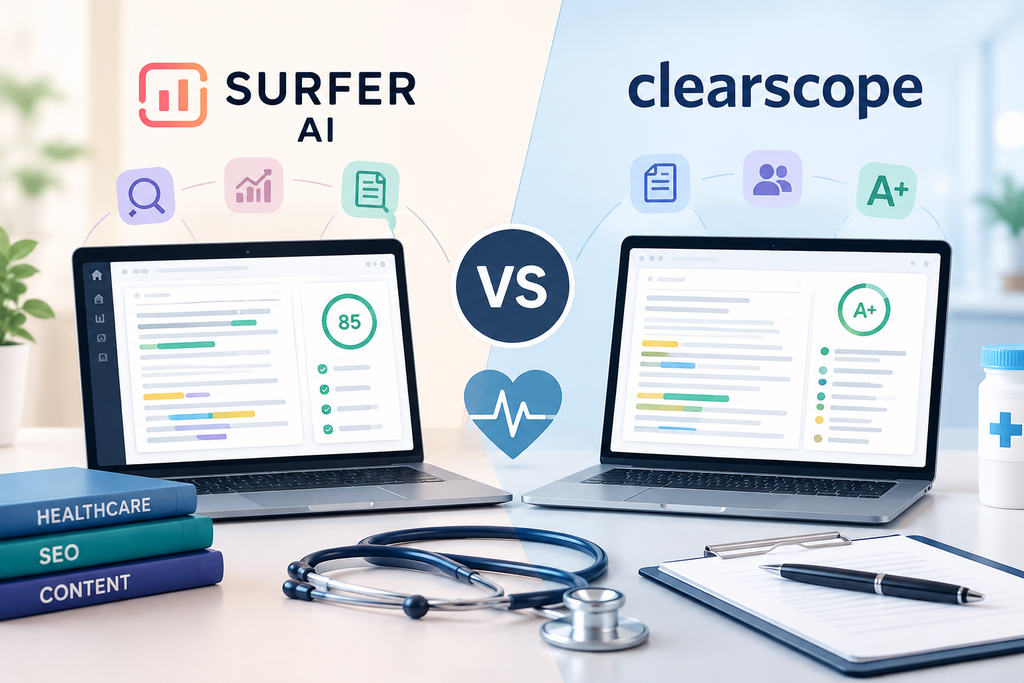
Surfer AI vs Clearscope: Side-by-Side Comparison
This is the core of any Surfer SEO vs Clearscope 2026 comparison: a direct, feature-by-feature look at where each tool actually wins.
| Factor | Surfer SEO / Surfer AI | Clearscope |
|---|---|---|
| Entry price (2026) | ~$49–$99/month | ~$129/month |
| Top-tier plan | $299/month (Peace of Mind) before Enterprise | $399/month (Business) before Enterprise |
| Free trial | None (money-back guarantee only) | None |
| Seats | Limited by plan tier | Unlimited on every plan |
| Content editor / grading | Real-time NLP scoring | Real-time letter grade (F–A+) |
| Keyword research | Built in, with clustering | Limited; often paired with Ahrefs or Search Console |
| Topic/content strategy | Topical Map | Topic Explorations |
| Content audit at scale | Content Audit tool | Content Inventory module |
| AI visibility tracking | ChatGPT, Gemini, Perplexity and more (paid add-on) | ChatGPT and Gemini (built into higher tiers) |
| Google Docs integration | Yes | Yes |
| Best suited for | Teams wanting one tool for the full SEO workflow | Teams wanting a simple, accurate grading layer for writers |
| Healthcare/YMYL-specific features | None | None |
Why Healthcare Content Is a Different Game
Google classifies healthcare content as YMYL (“Your Money or Your Life”), which means it has significantly tighter quality criteria than regular blog content. Every website is evaluated based on Experience, Expertise, Authoritativeness, and Trustworthiness (E-E-A-T), but in healthcare digital marketing, these signals are considerably more important. Google (and increasingly, AI response engines) inquires about whether publications are produced or reviewed by qualified specialists, if writers are clearly identified with credentials, and whether there is proof of real-world clinical practice.
This is precisely why generic E-E-A-T tools for healthcare content rarely exist, as most SEO software treats credential-checking as a manual, human task rather than something automatable.
Since neither Surfer nor Clearscope checks this automatically, we built a free E-E-A-T Checker to fill exactly this gap for healthcare content teams.
Run your page through the free E-E-A-T Checker → and see instantly where your medical content is missing reviewer credentials, citations, or trust signals.
These criteria are much more important now that AI systems, not simply Google’s search results, choose what to cite. AI systems consistently favor content from established healthcare organizations, academic institutions, government agencies, and specialized healthcare brands, with a focus on visible credentials, medical review disclosures, and editorial oversight to ensure content is based on professional accountability rather than anonymous or unverified sources.
In this situation, an unreviewed AI draft becomes hazardous rather than mediocre. AI-only processes on YMYL subjects are dangerous since AI-written health content might misinterpret facts or create bland, homogeneous advice that does not meet quality requirements. The solution is not to ignore AI tools; rather, it is to ensure that physicians, clinical writers, or skilled editors examine and, in many cases, considerably change AI drafts, with their names, qualifications, and review dates included in the final content.
What Both Surfer and Clearscope Are Missing for Healthcare Content
There is no medical reviewer workflow. Neither tool includes a place for attaching a reviewing physician’s name, license, or credentials to a draft, which E-E-A-T recommendations consider a crucial trust signal for YMYL pages.
No clinical citation checking: While both technologies identify the keywords and phrases used by top-ranking pages, neither evaluates if a health claim is supported by a peer-reviewed source, a medication label, or current clinical guidelines.
There is no YMYL compliance checklist: There is no built-in prompt to include a medical disclaimer, highlight a claim that requires citation, or identify wording that reads like individualized medical advice rather than general education.
This is the exact gap behind most searches for YMYL content optimization tools, and none of the mainstream platforms currently offer one.
There is no hallucination safety for medical truths because their AI drafting helpers (Surfer AI and Clearscope’s Draft with AI) are trained for general SEO writing rather than medical accuracy, doses, contraindications, or regulatory wording.
This is also why so many people now search for AI content tools that hallucinate medical facts; it is a documented, recurring risk with general-purpose AI writing assistants applied to clinical topics.
There is no HIPAA-compliant content advice for practices that post anything related to patient tales, case studies, or testimonials.
No specialty-specific SERP intelligence: A “content gap” solution designed for e-commerce or SaaS is unaware that a healthcare SERP is dominated by Mayo Clinic, Cleveland Clinic, and NIH results, altering what “ranking-worthy” content looks like.
This is the layer that healthcare brands genuinely require, and it is a service layer, not a software feature. This is also the precise gap that a specialist medical SEO partner is designed to fill.
In short, neither platform currently qualifies as a true best content optimization tool for healthcare websites on its own; both need this missing layer added around them.
None of These Alone Are Enough: How to Actually Create Perfect Healthcare Content
A high content-optimization score from Surfer or Clearscope indicates that your draft matches what is currently ranking. This does not imply that the content is medically correct, compliant, or trusted by AI response engines. Here is the technique that closes all of the gaps described above, and it is designed to work with whatever optimization tool you choose.
This section is essentially a practical answer to how to optimize medical blog content for Google once your chosen tool has already given you a high score.
Step 1: Start with the optimization tool, but treat its score as a floor, not a finish line
Use Surfer or Clearscope to see what phrases, structures, and word counts your rivals are utilizing. This informs you what you should cover. It does not inform you whether your writing is accurate, safe, or complete. Treat an A+ grade or a 90/100 content score as the minimal hurdle to clear before human review begins, rather than the sign-off.
Step 2: Assign a licensed medical reviewer to every YMYL page
- Determine whether pages are YMYL and if they provide information on diagnosis, treatment, medicine, procedures, symptoms, or results.
- Before publication, send each such draft to a licensed physician, nurse practitioner, pharmacist, or other appropriate professional.
- Publish the reviewer’s name, qualifications, and date of review on the site so that both readers and AI crawlers can see them.
- Keep a review diary so that if requested, you can prove who reviewed what and when.
This entire step is the foundation of physician-reviewed content SEO; without it, none of the remaining steps carry much weight with Google or AI systems.
Step 3: Back every clinical claim with a real, checkable source
- Cite peer-reviewed publications, government health authorities (CDC, NIH, WHO), or professional medical societies, rather than other blogs.
- Instead of paraphrasing, link directly to the original source.
- Any AI-drafted language that includes a number, dose, or assertion of “current guidance” should be flagged for manual fact-checking before publication; this is the single highest risk category for hallucination.
- Update older pages when guidance changes; a dated “medically reviewed” stamp with no update history is a poor trust signal in and of itself.
Step 4: Run a YMYL compliance pass before publishing
Teams building their own medical content SEO checklist can use the six questions below as a starting template.
Create a quick checklist that your editorial team uses on every health page:
- Does the page offer a clear medical disclaimer when applicable?
- Is customized medical advice language (“you should take”) replaced by general education language (“your doctor may recommend”)?
- Are all data, doses, and claims documented and dated?
- Is the reviewing clinician identified with visible credentials?
- Does the page avoid making assertions that may be seen as guaranteed outcomes?
- Is there a method for a reader to quickly locate crisis or emergency assistance if the issue requires it?
Step 5: Build topical authority the way healthcare SERPs actually reward
Generic topical mapping tools compare pages based on their ranking, which is fine for most businesses. In healthcare, institutional sources such as the Mayo Clinic, Cleveland Clinic, NIH, and hospital systems rank at the top of practically every SERP. Beating that needs depth and credibility signals that competition systems cannot assess, as opposed to just matching their word count. Create content clusters centered on a problem or specialty, with linked pages covering symptoms, causes, diagnosis, therapy, and prevention, all evaluated by the same or coordinated clinical team, to increase the topical and authoritative depth that AI systems value.
Step 6: Monitor AI citations, not just Google rankings
Instead of browsing Google, an increasing number of patients use ChatGPT, Gemini, or Perplexity to ask health issues directly. Check to see whether your brand is acknowledged in those replies, and if not, look into whether it is due to a lack of author credentials, thin sourcing, or an absent reviewer byline. This is a newer discipline than traditional rank monitoring, and most in-house teams have yet to develop a workflow for it.
This step is what most people are really asking about when they search for AI overview optimization for healthcare; it is a distinct discipline from classic SEO rank tracking.
The results
Optimization tool score + licensed medical review + genuine citations + YMYL compliance + authority-depth content clusters + AI citation monitoring equals healthcare content that ranks on Google, is referenced by AI answer engines, and gains patient confidence. Skip any one layer, and the content may still perform well in Surfer or Clearscope while silently failing somewhere that matters.
Which Tool Should Healthcare Brands Choose?
Solo practitioners, tiny clinics, or a single content writer: Surfer’s reduced entry fee and larger toolbox (keyword research and content editor in one spot) provide additional value without the need for a separate membership.
This scenario is essentially what people mean by AI content tools for medical practices and the best AI writing tool for doctors; small teams need one affordable tool that covers research and writing together.
Multi-writer teams, hospital marketing departments, or agencies managing many clinic clients: Clearscope’s limitless seats drastically alter the economics, since a team of five authors does not compound the cost in the same way that seat-based pricing does elsewhere.
For larger organizations, this is the use case behind searches for the best content strategy tool for hospital marketing; team size, not just features, decides the better fit.
Teams who want full-funnel SEO (technical audits, backlink data, and keyword clustering) in a single login: Surfer’s bigger feature set covers more ground; Clearscope openly presents itself as a content-only layer and expects you to couple it with additional tools.
Teams whose key obstacles are accuracy and trust, not word count: Neither instrument can address this on its own. This is where a medical content and SEO partner, working with your preferred technology, may make a significant impact in rankings and AI citations.
Frequently Asked Questions
Is Surfer AI or Clearscope better for medical websites?
Surfer has additional functionality (keyword research, content audit, topical mapping) and a lower starting fee, but Clearscope provides a simpler grading experience with unlimited team seats. Neither program contains capabilities designed expressly for medical E-E-A-T or YMYL compliance; therefore the best decision is based on team size and process, not healthcare-specific capability.
Does Surfer SEO or Clearscope check for medical accuracy?
No. Both technologies look at what phrases and themes top-ranking rival pages mention, not whether a health claim is medically true or well referenced. Medical accuracy checks demand a professional reviewer rather than a content optimization technology.
Can AI-generated healthcare content rank on Google?
Yes, but only if it follows Google’s E-E-A-T requirements for YMYL content, which include that it be examined by a competent expert, have clear author credentials, and avoid unsubstantiated or hallucinated claims. Purely AI-written health content without human medical assessment is more likely to rank low and be flagged for accuracy concerns.
This question is essentially the everyday version of does AI content rank for medical keywords?”, and the honest answer is: only with human medical review attached.
What is the difference between Surfer SEO and Clearscope pricing?
Surfer’s 2026 plans begin $49–$99 per month and range up to $999 for Enterprise. Clearscope starts at $129 per month, with a Business tier of $399 per month and configurable Enterprise pricing. Clearscope plans feature unlimited users; Surfer cost varies according on team size and add-ons like as AI Tracker and SERP Analyzer.
Do Surfer or Clearscope have a free trial?
As of 2026, neither tool has a free tier. Both either provide brief money-back guarantees or restricted trial credits based on current deals, so it’s worth visiting each vendor’s website before committing.
What should healthcare content teams look for beyond Surfer or Clearscope?
Look for a workflow that includes a licensed medical review, visible author credentials, accurate citations to clinical sources, and a YMYL compliance check in addition to any optimization tool you employ. This is the layer that truly safeguards rankings and AI citations for health content.
Key Takeaways
- Surfer SEO provides a more comprehensive on-page SEO toolbox at a cheaper starting fee, whereas Clearscope provides a simpler, more accurate grading experience with unlimited seats for a higher price.
- Neither instrument has features especially designed for medical E-E-A-T, YMYL compliance, or clinical citation verification.
- AI-only healthcare content poses a genuine danger of factual inaccuracies and weak trust signals; human medical assessment is still required regardless of whatever technology is used.
- Perfect healthcare content consists of six layers: an optimization score, a licensed medical review, actual citations, a YMYL compliance pass, authority-depth content clusters, and AI citation monitoring.
- The correct tool relies on team size and workflow requirements, not whatever tool is “better” in a vacuum.
- The greater potential for healthcare businesses is not selecting the correct software, but rather partnering that software with a partner that knows medical SEO, E-E-A-T, and compliance.
Take the Next Step
Surfer and Clearscope may help you create content that outperforms competitors. Neither can tell you if a claim regarding a medicine, symptom, or therapy is genuinely safe to write, or if your content fulfills the trust signals that AI systems now expect before citing you.
This is the gap that MedRankSEO covers. We integrate medical SEO strategy, E-E-A-T-compliant content structure, and physician-reviewed accuracy checks into the content optimization technologies currently in your stack, ensuring that your healthcare content not only scores well, but also ranks, is referenced by AI answer engines, and gains patient confidence.
Contact MedRankSEO today for a free SEO consultation to determine your healthcare content’s E-E-A-T and AI exposure.